Published on: September 4, 2026
MLOps and AI Testing Services: How to Deploy and Validate AI Without Breaking Your Business
Home » Blogs » IT-Services »
[10 mins read]

The most expensive AI failures do not happen during development. They happen after deployment — when a model that performed well in testing begins producing wrong outputs at scale, when data distributions shift and nobody notices, when an AI system makes consequential errors that damage customer relationships or regulatory standing before anyone catches the problem. These failures are not caused by bad engineering. They are caused by the absence of the operational infrastructure — MLOps — and the testing practices that ensure AI systems behave reliably in production, not just in controlled development environments.
For growing businesses deploying AI, understanding MLOps and AI testing services is not optional. It is the difference between AI that compounds in value over time and AI that creates more problems than it solves.
What MLOps is and why it matters
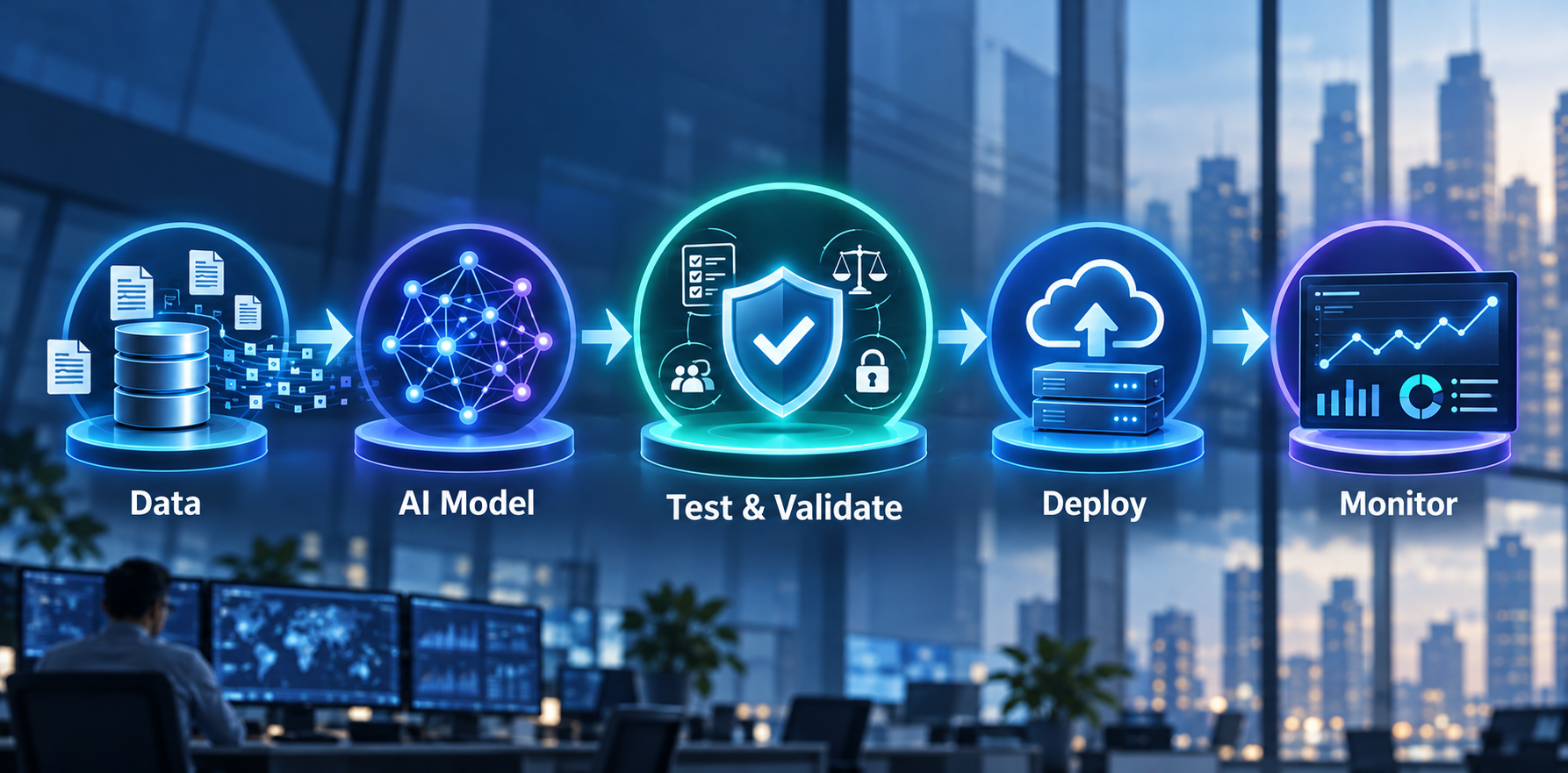
MLOps — Machine Learning Operations — is the set of practices, tools, and infrastructure that manages the lifecycle of machine learning models in production. It is the AI equivalent of DevOps in software engineering: the operational discipline that makes it possible to deploy, monitor, update, and iterate AI systems reliably and at scale. Without MLOps, AI deployments face a predictable set of problems.⚠️ Models degrade silently — a model trained on data from eighteen months ago may be producing increasingly poor outputs today because the world it was trained on no longer matches the world it is operating in. Without monitoring, nobody knows until customers or employees start complaining — or until the cost of the errors becomes visible in business metrics.
⚠️ Experiments cannot be reproduced — without experiment tracking, the conditions that produced a good model are not recorded, so retraining starts from guesswork rather than a documented baseline.
⚠️ Deployment is slow and risky — without a defined deployment pipeline, every model update is a manual, error-prone process.
⚠️ Multiple models become unmanageable — without a model registry and governance framework, nobody has a clear picture of what models are running, what data they were trained on, when they were last updated, or who is responsible for them.
MLOps addresses all of these problems systematically — creating the operational infrastructure that makes AI deployment as reliable and manageable as software deployment.
The core components of MLOps services
CI/CD pipelines for ML — automated pipelines that test, validate, and deploy model updates in a controlled, repeatable way. Reduces deployment risk and accelerates the iteration cycle.Experiment tracking — systematic recording of every model training run so experiments can be reproduced, compared, and built on. Tools like MLflow, Weights & Biases, and Neptune provide this capability.
Model registry — a centralized catalogue of all models in production and development, with metadata covering training data, performance metrics, deployment status, and governance information.
Feature stores — centralized repositories of the engineered features used to train and serve models, ensuring consistency between training and production environments. Feature store inconsistency — where the features used in training differ from those available at inference time — is one of the most common causes of model performance degradation in production.
Model monitoring — continuous tracking of model performance in production, including data drift detection, concept drift detection, prediction distribution monitoring, and business metric correlation. Model monitoring is the early warning system that catches degradation before it becomes a business problem.
Infrastructure automation — automating the provisioning and management of compute infrastructure using Kubernetes, containerized model serving, and infrastructure-as-code reduces operational overhead and improves reproducibility.
What AI testing services cover
AI testing is distinct from traditional software testing. A conventional software function either produces the correct output or it does not. AI systems are probabilistic — they produce outputs on a spectrum of quality, and acceptable quality depends on the use case and risk tolerance. Effective AI testing services address this complexity across several dimensions.✅ Functional testing — verifying the AI system produces outputs in the expected format, within acceptable latency, without crashing. The baseline that any AI system must pass before production consideration.
✅ Accuracy and performance testing — evaluating model performance against held-out test datasets using metrics appropriate to the model type. Performance testing must use evaluation datasets that genuinely represent production conditions — not curated test sets that overstate real-world performance.
✅ Bias and fairness testing — evaluating whether the model produces systematically different quality outputs for different demographic groups or input distributions. Bias in AI systems creates regulatory risk, reputational risk, and in some cases legal liability. Bias testing must be a standard component of any AI deployment process.
✅ Adversarial testing and red-teaming — systematically attempting to produce model failures through edge cases and prompt injection attempts. Red-teaming identifies failure modes that functional and accuracy testing do not surface — the edge cases that will eventually appear in production.
✅ Integration testing — verifying the AI system behaves correctly when integrated with downstream and upstream systems. Integration failures are a common cause of production AI incidents that were not caught during isolated model testing.
✅ Load and performance testing — validating acceptable latency and accuracy under production load conditions. Many AI systems that perform well at low request volumes degrade significantly under real-world traffic patterns.
✅ Regression testing — verifying that model updates improve target metrics without degrading performance on other dimensions. Regression failures — where an update improves one metric while worsening another — are common in AI systems and require systematic detection.
LLM-specific testing considerations
Large language model applications require testing approaches that go beyond traditional ML testing because the output space is effectively infinite and the failure modes are qualitatively different.🔹 Factuality and hallucination testing — LLMs can produce confident, fluent outputs that are factually incorrect. For business applications where accuracy matters — customer service, document Q&A, compliance assistance — systematic hallucination testing is essential. This involves curating question sets with known correct answers and measuring the rate and nature of factual errors.
🔹 Prompt injection testing — LLM applications can be manipulated by adversarial inputs that cause the model to ignore its system instructions, reveal sensitive information, or produce harmful outputs. Prompt injection testing systematically attempts these manipulations to identify vulnerabilities before deployment.
🔹 Output consistency testing — LLMs can produce inconsistent outputs for semantically equivalent inputs. For business applications where consistency matters — legal document review, customer communication, medical information — testing output consistency across paraphrased inputs is important.
🔹 Retrieval accuracy testing — applications using retrieval-augmented generation depend on retrieving the right documents or chunks before generating answers. Testing retrieval accuracy — whether the system retrieves the relevant information for a given query — is a distinct testing requirement from testing generation quality.
When growing businesses need MLOps and AI testing services
You are moving from a proof of concept to production deployment. The most critical transition in any AI project is from a controlled development environment to a production system handling real business data and real user interactions. MLOps infrastructure and systematic testing are what make this transition safe. Skipping them to accelerate deployment consistently results in production failures that are more expensive to remediate than the investment in getting them right upfront.You have multiple AI models in production and no clear governance. When a business reaches the point of running several AI models in production — for different use cases, updated at different times, owned by different teams — model governance becomes critical. A model registry, experiment tracking, and monitoring infrastructure prevents the operational chaos that otherwise results.
Your AI system is making consequential decisions. Customer communications, financial calculations, medical information, legal document review, hiring recommendations — any AI application where errors have significant downstream consequences requires more rigorous testing and monitoring than internal productivity tools. The stakes determine the appropriate investment in testing and operational infrastructure.
You are experiencing unexplained AI performance degradation. If an AI system that worked well when deployed is now producing noticeably worse outputs, data drift or concept drift is the most likely cause. MLOps monitoring infrastructure —specifically data drift and model performance monitoring — provides the diagnosis and the early warning system for future degradation.
How iFlow delivers MLOps and AI testing services
iFlow’s MLOps services cover the full operational infrastructure for AI systems in production — CI/CD pipelines for model deployment, experiment tracking and model registry implementation, feature store design, model monitoring with drift detection, and infrastructure automation on AWS, Azure, and Google Cloud.Our AI testing services include functional and performance testing, bias and fairness evaluation, adversarial and red-team testing for LLM applications, integration testing, and regression testing frameworks that travel with the model through its production lifecycle.
We work with growing businesses deploying AI for the first time who need MLOps infrastructure built from the ground up, and with businesses that have existing AI deployments and need operational maturity and governance added to systems that were originally deployed without it.
Talk to iFlow about MLOps and AI testing for your business. Learn more on our Technology Solutions page.
Frequently asked questions
Q1. What is MLOps and why does a business need it?Ans: MLOps — Machine Learning Operations — is the set of practices, tools, and infrastructure that manages the lifecycle of AI and machine learning models in production. It covers experiment tracking, model deployment pipelines, model monitoring, feature stores, model registries, and infrastructure automation. Businesses need MLOps because AI systems deployed without operational infrastructure degrade silently, cannot be updated safely, become unmanageable as the number of models grows, and create significant technical debt that compounds over time.
Ans: DevOps manages the lifecycle of software applications — code, tests, deployment pipelines, and monitoring. MLOps extends these principles to machine learning systems, which have additional operational complexity: models degrade over time as data distributions change, training and serving environments must be kept consistent, experiments must be tracked to enable reproduction, and model performance requires different monitoring metrics than software uptime. MLOps tools and practices address these ML-specific operational challenges alongside the standard DevOps requirements.
Ans: AI testing services cover functional testing (correct output format and basic behavior), accuracy and performance testing against evaluation datasets, bias and fairness testing, adversarial and red-team testing to identify failure modes, integration testing with upstream and downstream systems, load and performance testing under production traffic conditions, and regression testing when models are updated. For LLM applications, additional testing covers hallucination and factuality, prompt injection vulnerabilities, output consistency, and retrieval accuracy for RAG systems.
Ans: Traditional software testing verifies that functions produce correct outputs for defined inputs — testing is binary. AI testing evaluates outputs that exist on a spectrum of quality and are probabilistic rather than deterministic — the same input can produce different outputs, and acceptable quality depends on the use case and risk tolerance. AI testing requires evaluation datasets, performance metrics appropriate to the model type, bias assessment, and adversarial testing that traditional software testing frameworks are not designed to handle.
Ans: The right time to invest in MLOps infrastructure is before the first production AI deployment — not after. Building monitoring, deployment pipelines, and experiment tracking from the start costs less than retrofitting them onto systems already in production and avoids the production incidents that occur in the gap. For businesses already running AI in production without MLOps infrastructure, the trigger is typically either a production incident, performance degradation, or the point where multiple models in production create management complexity that is no longer sustainable.
Ans: MLOps infrastructure setup — CI/CD pipelines, experiment tracking, model registry, and monitoring — typically ranges from $30,000 to$80,000 for initial implementation depending on the number of models, the complexity of the infrastructure, and the cloud platform involved. Ongoing MLOps management runs$3,000 to $8,000 per month. AI testing services for a specific model or application typically range from $10,000 to $40,000 depending on the testing scope and the risk profile of the application.
Related reading
Custom AI development and machine learning consulting