Published on: July 27, 2026
B2B Marketing Automation for Service Businesses: What It Is, What It Does, and How to Get It Right
[13 mins read]

Most B2B service businesses are leaving pipeline on the table. Not because they are not generating leads, and not because their sales team is underperforming. Because the space between a lead coming in and a conversation being ready to happen is not managed. Leads go into a spreadsheet or a basic CRM, a follow-up email goes out manually if someone remembers, and the leads that were not ready to buy in the first week quietly go cold while the team focuses on the ones that were.
Marketing automation fixes this. Not by replacing human judgment, and not by creating an impersonal experience that turns off sophisticated B2B buyers. When it is implemented well, B2B marketing automation creates a systematic, personalized process for staying relevant to your prospects across the full length of a decision cycle that often runs weeks or months. It means that the prospect who downloaded your guide in January but was not ready to engage until April has been hearing from you consistently in the interim, has seen your thought leadership, has been reminded of your relevant case studies, and arrives at the April conversation already familiar with your positioning and your credibility.
This guide covers what B2B marketing automation actually involves for service businesses, which tools are worth evaluating, how to build a system that works without becoming a maintenance burden, and the mistakes that cause most automation implementations to underdeliver.
What B2B Marketing Automation Actually Means
Marketing automation is a broad term that gets applied to a wide range of tools and practices, which is part of what makes it confusing for service businesses trying to evaluate where to start.
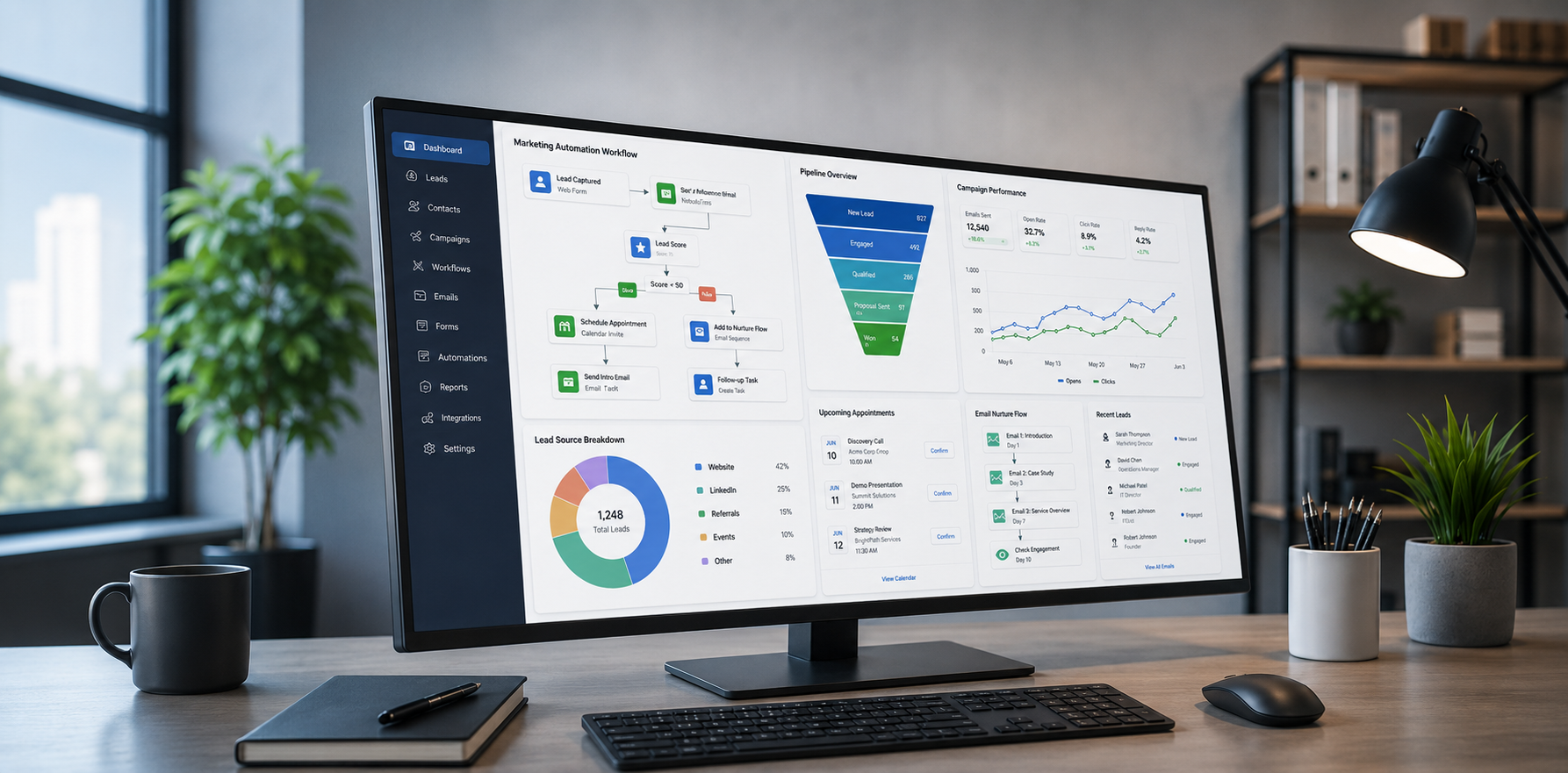
At its most basic, marketing automation is the use of software to trigger and deliver marketing communications based on defined rules and contact behaviors, without manual intervention for each send. A contact fills out a form on your website. The system automatically sends a confirmation email, adds them to the appropriate segment in your CRM, assigns a follow-up task to the relevant sales rep, and enrolls them in a nurture sequence tailored to the content they engaged with. None of that requires a human to execute each step individually.
At a more sophisticated level, B2B marketing automation covers lead scoring, which assigns point values to contact behaviors and profile characteristics to identify which leads are most sales-ready at any given moment. It covers dynamic content personalization, where different contacts receive different versions of an email or landing page based on their industry, job title, or prior engagement. It covers multi-channel orchestration, coordinating the timing and content of email, paid retargeting, LinkedIn outreach, and sales rep touches into a coherent sequence rather than disconnected activities.
For B2B service businesses specifically, the highest-value automation use cases cluster around a few specific workflows.
Lead capture and immediate follow-up covers the critical first window after a prospect takes an action on your website or engages with your content. Research consistently shows that response speed in the first hour after a lead action dramatically affects conversion rates. Automation ensures that response happens instantly and consistently, regardless of time of day or what else the sales team is working on.
Lead nurturing over a longer cycle covers the systematic process of staying relevant to prospects who are not yet ready to buy. For B2B service businesses with sales cycles of four to twelve weeks or longer, the ability to deliver useful, relevant content to a prospect over that period without requiring manual effort for each touchpoint is a genuine competitive advantage. The prospects that are nurtured well are more educated, more confident in your credibility, and further along in their decision process when they are finally ready to engage.
Pipeline acceleration covers automation that is triggered by sales activity rather than marketing activity. When a proposal is sent, an automated follow-up sequence kicks in. When a prospect visits a pricing page after an initial meeting, the sales rep gets a notification. When a deal has been sitting without activity for two weeks, an automated task reminds the rep to re-engage. These use cases live at the boundary between marketing automation and sales enablement, and they are where automation often delivers the highest direct revenue impact for service businesses. The visibility that automation provides into prospect behavior after initial contact, specifically what content they are consuming, which pages they are visiting, and how their engagement is trending, gives sales reps context that makes every follow-up conversation more informed and more relevant.
Re-engagement automation covers the contacts in your database that have gone cold. For most B2B service businesses, the existing contact database contains a significant number of leads that engaged at some point, were not ready at the time, and have since gone quiet. A well-designed re-engagement sequence delivers value-focused content to these contacts over a defined period to reactivate interest. The conversion rate on re-engagement sequences is typically lower than on fresh lead nurturing, but the cost of reaching existing contacts is a fraction of the cost of generating new ones, which makes re-engagement one of the highest-return automation use cases available to most service businesses.
The B2B Marketing Automation Stack for Service Businesses
Understanding the technology components involved helps you make better decisions about where to invest and how to sequence the buildout.
The CRM is the foundation. Marketing automation without a functioning CRM is a system that generates activity with no durable record of what happened, who it happened with, and what the outcome was. For B2B service businesses, the CRM is where every contact, every interaction, every deal, and every outcome lives. The marketing automation layer sits on top of it and depends on the quality of the data in it. Getting your CRM in order before building automation on top of it is not optional.
The email marketing and automation platform manages the creation, scheduling, and delivery of automated email sequences, as well as the trigger logic that determines when contacts enter and exit those sequences. For most B2B service businesses, this capability is either built into the CRM platform, as it is in HubSpot, or connected to it through an integration, as with Mailchimp, ActiveCampaign, or similar tools. The right choice depends on your existing stack, your team’s technical comfort level, and the complexity of the automation you need to build.
Lead capture and conversion tools cover the forms, landing pages, chatbots, and pop-ups that collect contact information and trigger automation sequences. The quality of these touchpoints determines the volume and quality of contacts entering your automation system. A poorly designed form on a poorly designed landing page creates a bottleneck at the very entry point of the funnel.
Lead scoring and segmentation logic determines how contacts are categorized and prioritized within the system. A basic lead score might weight job title, company size, and email engagement. A more sophisticated model incorporates website behavior, content consumption patterns, and explicit qualification data from forms. The right level of sophistication depends on your volume of leads and the capacity of your sales team to act on scoring signals.
Reporting and analytics infrastructure connects automation activity to pipeline and revenue outcomes. Without this layer, you cannot tell which sequences are performing, which content is driving engagement, which lead sources are producing the highest-quality contacts, or whether your automation investment is generating a measurable return. Most modern marketing automation platforms include reporting capability, but configuring it to surface the metrics that matter for your business requires deliberate setup.
Is your marketing infrastructure ready to support a B2B automation buildout? The iFlow Marketing Readiness Assessment gives you a scored view of your current marketing situation across seven dimensions in under three minutes.
Common B2B Marketing Automation Mistakes Service Businesses Make
The gap between what B2B marketing automation is supposed to do and what it actually delivers in most implementations comes down to a predictable set of mistakes.
Automating before the foundation is in place is the most common and most consequential mistake. Marketing automation amplifies what already exists in your marketing system. If your CRM data is incomplete, your segmentation is unclear, your content library is thin, and your lead capture is not converting, automation makes those problems more efficient, not better. The sequence that goes out to every lead regardless of where they came from or what they are interested in because nobody built the segmentation logic is not automation. It is mass email with extra steps.
Building complexity before proving the basics is a close second. The temptation with a powerful automation platform is to build every possible workflow before any of them have been tested and validated. The service businesses that get results from marketing automation consistently start with one or two high-value sequences, run them, measure them, optimize them, and then expand. Those that try to build a complete automation architecture in the first month typically end up with a partially built system that nobody fully understands and that gradually stops being maintained.
Treating automation as a replacement for personalization rather than an enabler of it is a mistake that damages the prospect relationship. B2B buyers are sophisticated. They recognize when they are in a generic sequence. The automation that works in B2B feels personal even when it is automated, because it is triggered by specific behaviors, uses language that reflects genuine understanding of the buyer’s situation, and delivers content that is actually relevant to where the buyer is in their decision process.
Neglecting the data quality that automation depends on causes sequences to send to the wrong people, trigger on incorrect behaviors, and produce reporting that is unreliable. A contact with a missing job title field gets included in a sequence designed for senior decision-makers. A lead source field that is inconsistently populated makes it impossible to accurately attribute pipeline to the right channels. Data hygiene is not glamorous, but it is what separates automation that works from automation that produces activity without results.
Failing to close the loop between marketing automation and sales follow-up undermines the investment at the critical handoff point. Marketing automation can warm a lead and signal readiness. It cannot close the deal. When automation identifies a lead as sales-ready and the sales rep does not follow up promptly, the automation investment is generating qualified pipeline that leaks out of a broken handoff process. The integration between your automation system and your sales team’s workflow is where most of the revenue impact of automation is either captured or lost.
How to Build a B2B Marketing Automation System That Works
A structured approach to building B2B marketing automation reduces the risk of a half-built system that nobody maintains and increases the probability of a system that generates measurable pipeline contribution.
Start with your highest-value use case. For most B2B service businesses, this is new lead follow-up. Build a sequence that responds to every new contact within minutes of their first action, delivers relevant content over the following two to four weeks, includes a clear sales-ready handoff trigger, and tracks engagement at each step. Get this sequence running, measure it, and optimize it before building anything else.
Define your segments before you build your sequences. Who are the different types of contacts that enter your system? What are their roles, their industries, their stages in the buyer journey? How should the content and timing of your automation differ for each segment? These definitions do not need to be exhaustive on day one, but they need to be clear enough that your sequences are sending relevant content to the right people rather than the same thing to everyone.
Map your content to the buyer journey. B2B marketing automation is only as good as the content it delivers. Awareness-stage contacts need content that helps them define and understand their problem. Consideration-stage contacts need content that helps them evaluate their options. Decision-stage contacts need content that helps them build the business case for choosing you. If your content library has gaps at any of these stages, building sequences that require content you do not have will stall the automation buildout.
Build your reporting before you launch. Define the metrics you will use to evaluate whether the automation is working: email open rates, click rates, sequence completion rates, leads handed to sales, and pipeline generated from automation-sourced contacts. Configure your reporting to track these metrics from the day you launch, so you have data to optimize against from the beginning.
Review and optimize on a defined cadence. Marketing automation is not a set-and-forget system. The sequences, the timing, the content, the scoring model, and the segmentation logic all need to be reviewed and updated as you learn what works and as your business context changes. A quarterly automation review is a minimum. Monthly is better for businesses with high lead volume.
iFlow’s marketing solutions team helps B2B service businesses design and implement marketing automation systems that generate pipeline rather than activity. If you want to understand where your current marketing setup stands before investing in automation, the iFlow Marketing Readiness Assessment gives you a scored view in under three minutes.
Talk to iFlow for your B2B Marketing Automation
Frequently Asked Questions
Ans: B2B marketing automation is the use of software to trigger and deliver marketing communications based on defined rules and contact behaviors, without manual execution of each step. It covers lead capture follow-up, lead nurturing over longer sales cycles, lead scoring and prioritization, pipeline acceleration sequences, and the reporting infrastructure that connects automation activity to revenue outcomes.
Ans: HubSpot is the most commonly recommended all-in-one platform for B2B service businesses, combining CRM, email marketing, automation, and reporting in a single integrated system. ActiveCampaign is a strong alternative for businesses that want powerful automation at a lower price point. Marketo is appropriate for larger B2B organizations with more complex automation requirements and dedicated marketing operations resources. The right choice depends on your existing stack, your team’s technical capability, and the complexity of the automation you need.
Ans: A focused implementation covering one to two core sequences, basic lead scoring, and CRM integration can be live within four to eight weeks for a business with a functioning CRM and an existing content library. A more comprehensive buildout covering multiple segments, full journey mapping, and advanced scoring typically runs two to four months. The timeline is heavily influenced by the state of your existing data and the availability of relevant content.
Ans: Realistic expectations for a well-implemented automation system include meaningful improvement in lead response speed, higher engagement rates with content across the nurture cycle, improved visibility into which leads are most sales-ready at any given moment, and measurable pipeline contribution from automation-sourced and automation-nurtured contacts within the first two quarters of operation. The specific results depend heavily on lead volume, content quality, and the effectiveness of the sales follow-up process.
Ans: Platform costs vary significantly. HubSpot’s Marketing Hub ranges from $800 to $3,200 per month for the tiers most commonly used by B2B service businesses. ActiveCampaign ranges from $150 to $500 per month for comparable functionality at smaller scale. Implementation and configuration costs depend on whether you build in-house or work with a partner, and typically range from $5,000 to $25,000 for a focused initial buildout. Ongoing optimization is an additional cost typically covered by a marketing agency retainer or internal marketing operations resource.
Ans: Not necessarily, but the implementation quality is significantly higher when there is experienced guidance involved. The businesses that try to build complex automation systems without prior experience typically end up with partially built, poorly maintained systems that do not deliver the intended results. A fractional marketing team or a B2B marketing agency with marketing automation expertise can compress the implementation timeline, avoid the common mistakes, and build a system that is set up to be maintained and optimized over time.
Related Reading
What Is a Fractional Marketing Team – and Does My Small Business Need One?
How to Choose a Performance Marketing Agency: What to Look For, What to Avoid, and What to Expect
What is a B2B Digital Marketing Agency and Does Your Business Need One?