Published on: May 15, 2026
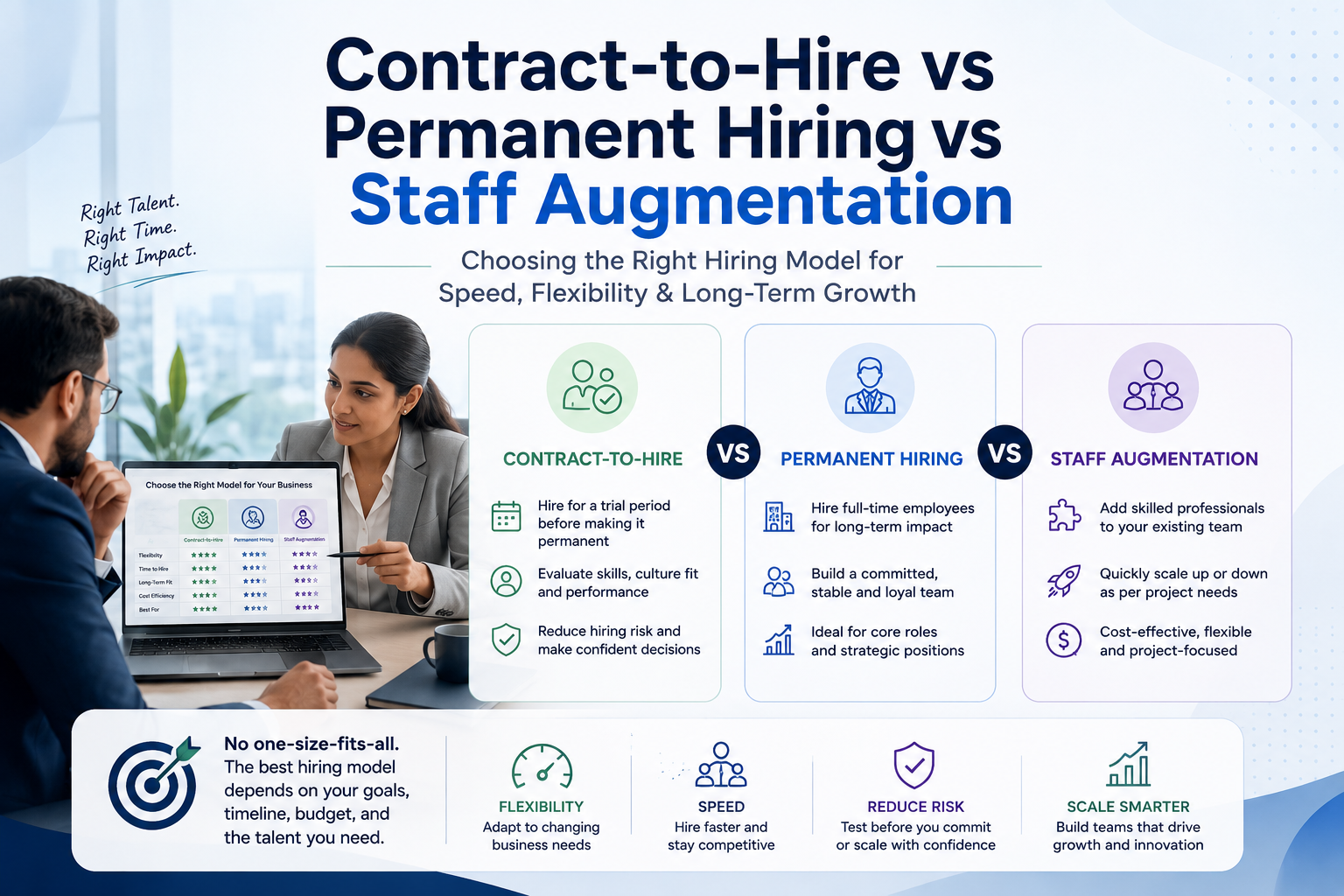
Contract-to-Hire vs Direct Hire vs Staff Augmentation: Which Hiring Model?
[11 mins read]

Three Hiring Models, One Critical Decision.
Your VP of Engineering needs three developers. Yesterday.
Your options:
1. Direct hire — Post the job, recruit, hire as full-time employees
2. Contract-to-hire — Bring them on as contractors for 60–90 days, then decide
3. Staff augmentation — Engage contractors for the project duration, no conversion expected
Each model changes everything: your timeline, your budget, your risk, and your team structure.
Get it right: you fill critical roles fast, stay flexible, and build a high-performing team.
Get it wrong: you overpay, lock yourself into poor fits, or create team instability.
This guide breaks down all three models with real numbers, decision frameworks, and clear guidance on when to use each one.
By the end, you’ll know exactly which approach fits your situation.
Download our Fast Track guide to scaling Tech Teams!
The three models explained
Direct Hire (Permanent / Full-Time Employment)
What it is: Traditional employment. You recruit, interview, and hire someone as a full-time employee with salary, benefits, and long-term commitment.
Engagement: The engagement is a permanent employment relationship with a full benefits package, and the person becomes part of your official headcount.
Timeline: Expect 6–8 weeks to hire and 2–4 weeks of onboarding before they’re fully productive.
Contract-to-Hire (Try Before You Buy)
What it is: You engage someone as a contractor through a staffing agency for 60–90 days. During this period you evaluate their performance, cultural fit, and technical abilities. At the end, you can convert them to full-time employment, extend the contract, or end the engagement cleanly.
Engagement: The agency handles payroll and benefits during the contract period. A conversion fee — typically 15–20% of annual salary — applies if you hire them.
Timeline: A contractor starts within 3–7 days for a 60–90 day evaluation period, with the option to convert to a full-time employee if successful.
Staff Augmentation (Extended Contractor Engagement)
What it is: You bring in contractors — individually or as a team — to supplement your existing team for a specific project, timeframe, or skill gap, with no expectation of conversion.
Engagement: They work under your direction, billed hourly or monthly through the agency. Duration is flexible from weeks to years, and you can scale the team size up or down as needed.
Timeline: Start time is also 3–7 days. Duration varies by project need and can extend or reduce as needed
Side-by-side comparison
| Factor | Direct Hire | Contract-to-Hire | Staff Augmentation |
|---|---|---|---|
| Time to start | 6–8 weeks | 3–7 days | 3–7 days |
| Commitment level | Long-term | Medium-term test | Short-to-medium term |
| Cost (Year 1) | $180K–$220K | $130K–$180K | $150K–$190K |
| Flexibility | Low | Medium | High |
| Risk | High | Low | Medium |
| Benefits / overhead | You pay | Agency pays (during contract) | Agency pays |
| Cultural integration | Deep | Medium | Variable |
| Exit complexity | High (severance, legal) | Low (end contract) | Low (end contract) |
| Best for | Core team roles | Testing uncertain fits | Project-based needs |
Deep dive: Direct hire
When direct hire makes sense
Direct hire is the right call when you are hiring for core, strategic roles — engineering leads, architects, principal engineers, or product managers who will shape the roadmap and build culture. It works when you have 6–8 weeks to recruit properly, the role is permanent and well-defined with a stable budget, and cultural fit is critical to the team you are building.
The true cost of direct hire — Senior Full-Stack Developer example:
| Cost component | Annual amount |
|---|---|
| Base salary | $140,000 |
| Benefits (healthcare, 401k, etc.) | $42,000 |
| Payroll taxes | $10,700 |
| Recruiting (job ads, agency fee @ 20%) | $28,000 |
| Office space and equipment | $8,000 |
| Software licenses | $3,600 |
| Training and professional development | $2,500 |
| Total Year 1 cost | $234,800 |
Hidden costs not in this table:
- 100+ hours of team time spent on interviews
- 2–4 weeks of reduced productivity during onboarding
- Bad hire risk costing $80K–$240K if it doesn’t work out
Pros:
✅Long-term stability
✅Deep cultural integration
✅Clear IP ownership
✅Career development pathways
✅Team cohesion
✅Equity alignment
Cons:
❌Slowest option- 6-8 weeks minimum
❌Highest risk – Expensive if it doesn’t work out
❌Inflexible – Hard to adjust if needs change
❌Highest overhead – Benefits add 40-50% to salary
❌Complex exit – Severance, legal considerations if you need to terminate
Read more on Contract vs Permanent Tech Hiring: What’s Right for Your Business?
Deep dive: Contract-to-hire
When contract-to-hire makes sense
Contract-to-hire is the right model when you are uncertain about long-term need, want to de-risk the hiring decision after previous bad hires, need someone fast but the role could become permanent, or are in a growth phase where direction is still evolving. The 60–90 day trial period lets you see real performance, assess cultural fit, and validate skills before making a full commitment.
The true cost of contract-to-hire — Senior Full-Stack Developer (90-day contract, then convert):
First 90 days (contract):
| Cost component | Amount |
|---|---|
| Hourly rate ($85/hr × 520 hours) — first 90 days | $44,200 |
| No benefits (agency handles) | $0 |
| No recruiting cost | $0 |
| No equipment (remote, uses own) | $0 |
| 90-Day Cost | $44,200 |
Conversion to FTE (if you hire):
| Cost component | Amount |
|---|---|
| Conversion fee (18% of $140K salary) | $25,200 |
| Remaining 9 months as FTE | $176,100 |
| Year 1 Total (including contract period) | $245,500 |
If you DON’T convert: You’ve only spent $44,200 and can walk away cleanly.
Risk reduction value: Priceless.
Pros:
Cons:
Real example — Contract-to-hire in practice: A fintech startup in Austin needed a DevOps engineer urgently for a cloud migration, but was uncertain if the role would be needed long-term once migration completed.
Hired through iFlow on a 90-day contract-to-hire at $95/hr.
The engineer started in 4 days, completed the migration in 60 days, demonstrated strong team fit, and was converted to FTE on day 75 — still with the company 18 months later as senior DevOps lead.
Total evaluation period cost: $79,400.
A direct hire attempt would have taken 6–8 weeks and potentially missed the migration deadline entirely.
Read more on Staff Augmentation vs Full-Time for Urgent Needs
Deep dive: Staff augmentation
When staff augmentation makes sense
Staff augmentation works best when you have a defined project with a clear end date — an MVP build, system migration, or seasonal feature rollout. It is also the right fit when you need specialized skills temporarily (AI/ML, mobile, security), your core team is temporarily overloaded, or you want maximum flexibility to scale up or down as scope and budget evolve.
The true cost of staff augmentation — Senior Full-Stack Developer (6-month engagement):
| Cost component | Amount |
|---|---|
| Hourly rate ($85/hr × 1,040 hours) | $88,400 |
| Benefits, recruiting, equipment, conversion fee | $0 |
| 6-month total | $88,400 |
| Equivalent 6 months of direct hire FTE | $117,400 |
| Savings vs Direct hire | $29,000 (24.7%) |
Plus: Easy to extend or end as needed.
Pros:
Cons:
Real example — Staff augmentation in practice: A healthcare SaaS company in North Carolina had a 6-month backlog of features and technical debt, with a core team of four that was burned out.
Brought in three contract developers through iFlow for a 16-week sprint.
Contractors started in 5 days, cleared the backlog in 14 weeks ahead of schedule, the core team focused on strategic initiatives, and the engagement ended cleanly with full knowledge transfer.
Saved approximately $45,000 compared to hiring three FTEs for 6 months.
Read more on Quick-Start IT Staffing Models
Decision framework: Which model should you choose?
Work through these three questions in order to identify your best fit.
Question 1 — How urgent is this hire?
Need someone in under 2 weeks → Contract-to-hire or staff augmentation. Direct hire is too slow.
Have 6–8 weeks → All options are possible, proceed to Question 2.
Question 2 — Is this role permanent or temporary?
Permanent, core team role (12+ months) → Direct hire, or contract-to-hire if you want to test first.
Temporary, project-based (under 12 months) → Staff augmentation, or contract-to-hire if the project might become ongoing. Direct hire is an unnecessary commitment.
Question 3 — How certain are you about the role and fit?
Very certain, clear need, well-defined role → Direct hire if you have time; staff augmentation if project-based.
Somewhat uncertain, scope may change → Contract-to-hire for best risk mitigation.
Very uncertain, experimental, may not need long-term → Staff augmentation for maximum flexibility.
Quick decision matrix:
| Your situation | Best model | Why |
|---|---|---|
| Urgent need, uncertain long-term fit | Contract-to-hire | Speed + risk mitigation |
| Urgent need, definitely temporary | Staff augmentation | Fast, flexible, cost-effective |
| Strategic core role, have time | Direct hire | Deep investment, cultural fit |
| Project-based work (3–6 months) | Staff augmentation | Clear end date, no commitment |
| Testing new technology or approach | Contract-to-hire | Evaluate before committing |
| Covering unexpected departure | Contract-to-hire | Fast replacement, assess before deciding |
| Seasonal spike or backlog | Staff augmentation | Temporary scale, easy exit |
| Building long-term team | Direct hire | Permanent investment |
💰 Download: 2026 Tech Salary Benchmark Report. Compare costs across all three hiring models for 25 tech roles.
Download Free Report ➡️
The hybrid approach: combining all three models
Smart companies don’t pick one model for everything. They strategically blend all three based on the nature of each role.
A typical hybrid team structure might look like this:
Core team (Direct Hire): 1 Engineering Manager, 2 Senior Engineers / Tech Leads, 1 Product Manager — the stable foundation of the team.
Testing / growing team (Contract-to-Hire): 2 Mid-level Developers being evaluated for permanent conversion, 1 DevOps Engineer in trial period.
Project support (Staff Augmentation): 3 Frontend Developers on a 6-month feature build, 2 QA Engineers on a regression testing sprint.
The result is an 11-person team that combines stability from the core, flexibility from contractors, risk mitigation from the try-before-you-buy layer, and cost optimization — you pay premium rates only for the roles that warrant it.
Read more on Smart Tech Hiring at Scale: Build Teams Faster Without Burning Budget or Culture
Common mistakes to avoid
Using direct hire for everything. It is slow, inflexible, expensive, and high-risk. Use contract-to-hire or staff augmentation for uncertain roles.
Using staff augmentation for core roles. Knowledge walks out when the contract ends and there is no long-term investment in the business. Use direct hire or plan a conversion for strategic positions.
Skipping the contract-to-hire option entirely. Committing to full-time employment before seeing real performance is one of the most expensive mistakes in tech hiring. Test with contract-to-hire when uncertain about fit.
Not defining clear conversion criteria upfront. Vague expectations lead to awkward conversion decisions and contractor uncertainty. Set clear 30–60–90 day performance expectations at the start of the engagement.
Treating contractors like second-class team members. Poor integration leads to poor performance and early turnover. Integrate contractors fully into team rituals and communication from day one.
No knowledge transfer plan. When contractors leave, their knowledge leaves with them unless you plan for it. Document work, pair contractors with FTEs, and build handoff into the engagement timeline.
How iFlow supports all three models
iFlow offers flexible engagement across all three hiring models, with pre-vetted candidates and fast turnaround across all of them.
Contract-to-hire:
- Pre-vetted candidates ready in 48-72 hours
- A clear 60-90 day evaluation framework
- Transparent conversion fees (15-18% of annual salary)
- Ongoing and support through the full trial and conversion process.
Staff augmentation:
- Individual contributors or full project teams,
- Flexible duration from weeks to years,
- Easy scale up or down with 2-week notice,
- Onshore, Nearshore (LATAM), or Offshore options.
Direct hire:
- Full recruitment process management
- Technical vetting and cultural screening
- 90-day replacement guarantee
- Competitive placement fees (18-20%)
All models include
- Technical assessments before submission
- Fast turnaround (3-7 days to start)
- Transparent pricing, no hidden fees
- Dedicated account support
- Post-placement check-ins
Contact us to discuss which model fits your needs. ➡️
Making your decision
This week: Audit your current open roles and categorize each as core/strategic, project-based, or uncertain. Match each role to the appropriate hiring model.
This month: Test contract-to-hire for one or two uncertain roles, use staff augmentation for defined project work, and reserve direct hire for confirmed core positions.
This quarter: Build your hybrid team structure, track costs and outcomes by model, and optimize the mix based on results.
There is no universal best hiring model. The right choice depends on your timeline, your certainty, your budget, and whether the need is temporary or permanent. Most successful teams use all three strategically — not just one.
Ready to implement the right hiring model for your team? Contact iFlow today➡️
Frequently Asked Questions
Ans: Yes, but you’ll typically pay a conversion fee similar to contract-to-hire (15-20% of annual salary). Contract-to-hire is designed for this path, while staff augmentation assumes no conversion.
Ans: 60-90 days is standard. This gives you 2-3 months to assess real performance, cultural fit, and technical ability before committing to permanent employment.
Ans: 15-20% of the first-year annual salary. If you’re hiring someone at $140K, you can expect a $ 21K–$28K conversion fee. This is lower than traditional recruiting fees (20-25%).
Ans: Hourly rates are higher, but the total cost is often 20-30% lower when you factor in benefits, overhead, and no long-term commitment. Plus, you only pay for actual work time.
Ans: Absolutely. Most successful teams blend FTEs and contractors. The key is integrating contractors into team rituals, communication, and culture.
Ans: You simply don’t convert them, and the contract ends. Most agencies (including iFlow) will provide a replacement if the contractor isn’t performing within the first 30 days.
Ans: When you hire through a staffing agency, the agency typically provides benefits to their contractors. You pay a loaded hourly rate that covers this, but you don’t manage benefits directly.
Ans: Contract-to-hire and staff augmentation are tied (3-7 days). Direct hire is slowest (6-8+ weeks). If speed matters, avoid direct hire for urgent needs.