Published on: May 13, 2026
Google AI Overviews Explained: What They Are and How to Appear in Them
[9 mins read]

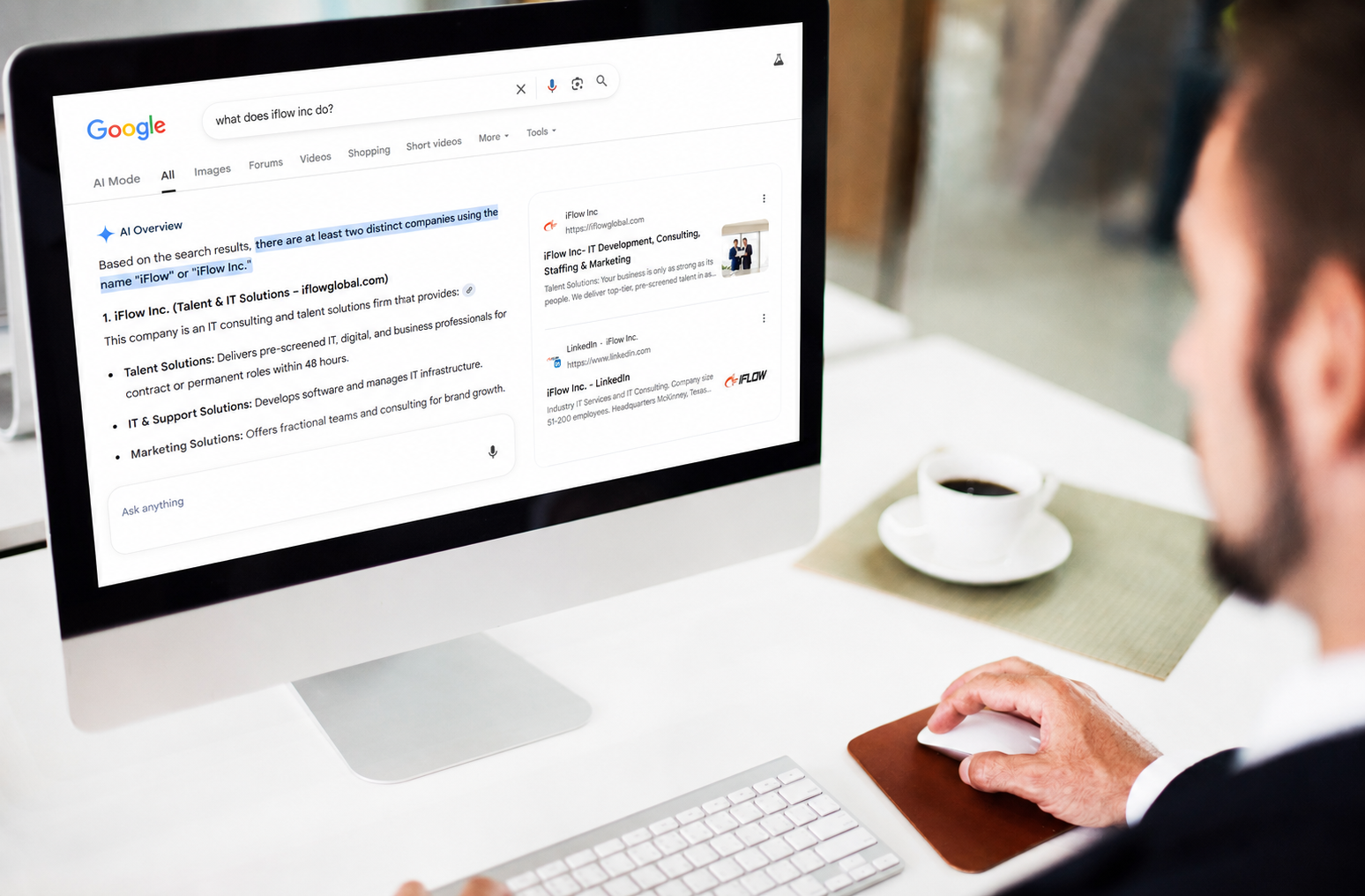
If you have done a Google search recently, you may have noticed something new at the top of the results page — before any of the traditional blue links appear. A shaded panel with an AI-generated summary of the answer to your query, sometimes with small source icons along the bottom.
That is Google AI Overview.
It is not a feature you can opt into as a business. It appears automatically for a growing range of search queries, and the businesses whose content is used to generate those summaries get visibility that sits above everything else on the page — including paid ads in some cases.
For small businesses trying to get found online, understanding how Google AI Overviews work — and what it takes to appear in them — is now as important as understanding how to rank in traditional search results.
What is Google AI Overview?
Google AI Overview (previously called Search Generative Experience, or SGE) is Google’s AI-powered answer feature that generates a written summary response to a search query and displays it at the top of the results page.
Instead of just showing a list of ranked websites, Google now reads multiple sources, synthesizes the key information, and writes a response in its own words — often citing two to five sources that contributed to the answer.
For the user, this means getting a direct answer without having to click through multiple websites. For businesses, it means the traditional “page one” is now two layers deep — AI Overview first, then the blue links below it.
The queries that trigger AI Overviews tend to be questions and informational searches — exactly the kind of searches buyers make when researching a service, comparing options, or trying to understand a topic before making a purchase decision. This makes AI Overviews particularly significant for B2B service businesses whose buyers research extensively before making contact.
How Google AI Overview decides what to include
Google does not publish an explicit rulebook for AI Overview inclusion, but based on how the feature operates, several clear patterns have emerged.
Direct, clear answers to the query. AI Overview consistently favors content that answers the specific question directly — with the answer in the first paragraph, not buried three scrolls down the page. Content that takes a long time to get to the point is less likely to be retrieved and used.
Content from pages that already rank well. AI Overview draws heavily from pages that Google already considers authoritative for the query topic. Strong traditional SEO — quality content, proper structure, relevant backlinks — remains the foundation. You cannot appear in AI Overview if Google does not already trust your content.
Structured, scannable content. Pages with clear headings, bullet points, numbered lists, and FAQ sections are easier for the AI to parse and extract relevant information from. Dense, unbroken paragraphs are harder to retrieve accurately.
Schema markup — especially FAQPage. Pages with FAQPage schema explicitly marked up are significantly more likely to contribute to AI Overview responses. Google can directly read the question-and-answer pairs and use them in generated summaries.
E-E-A-T signals. Google’s quality framework — Experience, Expertise, Authoritativeness, and Trustworthiness — applies to AI Overview sourcing. Content written by or clearly attributed to someone with genuine expertise in the topic is preferred over anonymous or generic content. This is why named authors with relevant credentials matter more now than they did two years ago.
How AI Overview is different from Featured Snippets ?
Featured Snippets — the boxed answer that sometimes appears at the top of Google results — have existed since 2014 and many businesses have optimized for them. AI Overview is related but meaningfully different.
A featured snippet pulls a specific excerpt verbatim from one source page. AI Overview synthesizes information from multiple sources and writes a new response. This means:
AI Overview can draw from your content even if it does not quote you directly. Multiple businesses can contribute to a single AI Overview response. Being the sole source of the answer is less important than being one of the credible sources Google draws from.
For small businesses, this is actually an opportunity. You do not need to be the single most authoritative source on a topic — you need to be one of the credible, well-structured sources Google pulls from when generating its answer.
What types of searches trigger Google AI Overviews
Not every search triggers an AI Overview. Google applies the feature selectively — more commonly for certain query types than others.
Queries that frequently trigger AI Overviews include questions beginning with what, how, why, when, and which. Comparison queries such as “fractional marketing team vs agency” or “contract vs permanent hiring.” Definition queries for industry terms. Research queries where the user is clearly gathering information rather than looking for a specific website.
Queries that less commonly trigger AI Overviews include branded searches for specific companies, local service searches with strong navigational intent, transactional searches where the user is ready to buy, and breaking news queries.
The implication for content strategy: The Blog posts and FAQ sections you write to answer early-stage buyer questions — “What is a Fractional Marketing Team“, “How long does SEO take“, “What does a Fractional CMO Do?” — are exactly the content types most likely to contribute to AI Overview responses.
Five things small businesses can do to improve AI Overview visibility
1. Structure every key page around one specific question. Each service page and blog post should be built around one clear question your buyer is asking. State the question, answer it directly in the first paragraph, then provide supporting detail. This mirrors exactly how Google’s AI extracts and uses content.
2. Add FAQ Page schema to all service pages and blog posts. FAQ Page schema tells Google explicitly what questions your page answers and what the answers are. This is one of the clearest signals a small business can send to improve both AI Overview inclusion and traditional featured snippet eligibility. Yoast SEO on WordPress makes this straightforward to implement.
3. Write with a named, credible author. Assign a real person as the author of every post. Include a short bio that establishes their relevant experience. Google’s E-E-A-T framework rewards content attributed to people with demonstrable expertise — anonymous posts are at a disadvantage in AI Overview sourcing.
4. Improve your existing high-traffic pages first. If you already have pages ranking on page one of Google, those pages are closest to AI Overview inclusion. Audit them for direct answers, clear structure, and FAQ Page schema — and update accordingly. This is faster than building new content from scratch and can produce results within weeks.
5. Publish consistently on your core topics. Topical authority — being a site that covers a topic thoroughly over time — is a significant factor in AI Overview sourcing. Publishing two to three posts per week consistently on your core subject areas builds this authority faster than sporadic publishing, however good the individual posts are.
The relationship between AI Overview and click-through rates
One concern businesses frequently raise is whether AI Overview reduces the number of people who click through to their website. If Google provides the answer directly, why would someone click?
The honest answer is: for some queries, AI Overview does reduce click-through rates on informational content. A user who just needed a quick definition may not click through at all.
But for B2B service businesses, this is less of a concern than it first appears. Buyers researching a service like fractional marketing or IT staffing are not making a decision based on a single AI summary. They use the overview to orient themselves, then click through to learn more, compare options, and evaluate specific providers. Appearing in the AI Overview for those research-stage queries puts your business in the consideration set — and that is where the value lies.
The businesses that appear consistently in AI Overviews for the questions their buyers ask become familiar before buyers ever visit their website. That familiarity shortens the trust-building journey and improves conversion when the buyer does eventually make contact.
How iFlow helps small businesses appear in Google AI Overviews ?
Appearing in Google AI Overviews requires the same foundation as strong traditional SEO — authoritative content, technical health, and consistent publishing — plus the additional layer of structured data, question-format content, and named authorship that AI Overview specifically rewards.
iFlow’s AI Search Visibility service builds this foundation for small businesses, working across content strategy, schema implementation, and ongoing publishing to improve visibility in AI Overviews, Claude, ChatGPT, Perplexity and traditional Google results simultaneously.
If you want to understand where your business currently stands and what it would take to start appearing in AI-generated answers, a free audit is the right starting point.
Book a free AI visibility audit
Read more about how we approach AI search visibility on our AI Search Visibility service page.
Frequently Asked Questions
Google AI Overview is an AI-generated summary that appears at the top of Google search results for many queries, above the traditional list of blue links. It synthesizes information from multiple sources and presents a direct answer to the user’s query, sometimes citing the sources it drew from. It was previously called Search Generative Experience (SGE) before Google made it a standard feature in 2024.
The most effective steps are: structure your content around specific questions with direct answers in the first paragraph, add FAQ Page schema markup to your key pages, publish consistently on your core topics to build topical authority, assign named authors with relevant credentials to your content, and ensure your pages already rank well in traditional Google search — AI Overview draws primarily from content Google already trusts.
It depends on the query type. For informational queries where the user just needs a quick answer, AI Overview can reduce click-through rates. For research-stage queries where buyers are evaluating options — which is the most B2B service searches — appearing in the AI Overview puts your business in the consideration set and typically supports rather than replaces website visits. The brand familiarity built through consistent AI Overview appearances also improves conversion when buyers do eventually visit.
No. A featured snippet pulls a specific excerpt verbatim from one source page. Google AI Overview synthesizes information from multiple sources and writes a new response in its own words. Multiple businesses can contribute to a single AI Overview, whereas a featured snippet has a single source. The content signals that help you earn featured snippets — direct answers, clear structure, schema markup — also help with AI Overview, but AI Overview is broader in scope.
No. Google applies AI Overview selectively. It appears most commonly for question-format queries, comparison searches, and informational research queries. It appears less frequently for branded searches, transactional queries, local directory-style searches, and breaking news. For B2B service businesses, the queries most relevant to their buyers — research and comparison searches — are among those most likely to trigger AI Overviews.
There is no fixed timeline, but businesses that implement the key signals — direct-answer content structure, FAQ Page schema, consistent topical publishing, named authorship —typically see improvement within eight to twelve weeks. Pages that already rank on page one of Google are closest to AI Overview inclusion and respond fastest to optimization.
Related Reading
How to Get Your Business Found on ChatGPT, Gemini, Claude, Copilot or any other LLM?
What is Generative Engine Optimization (GEO)?