Published on: May 11, 2026
What Is Generative Engine Optimization (GEO) and Why Does It Matter for Your Business?
[8 mins read]

If you have spent any time thinking about how your business gets found online, you have probably heard of SEO — Search Engine Optimization. It is the practice of making your website rank higher on Google so more people find you when they search.
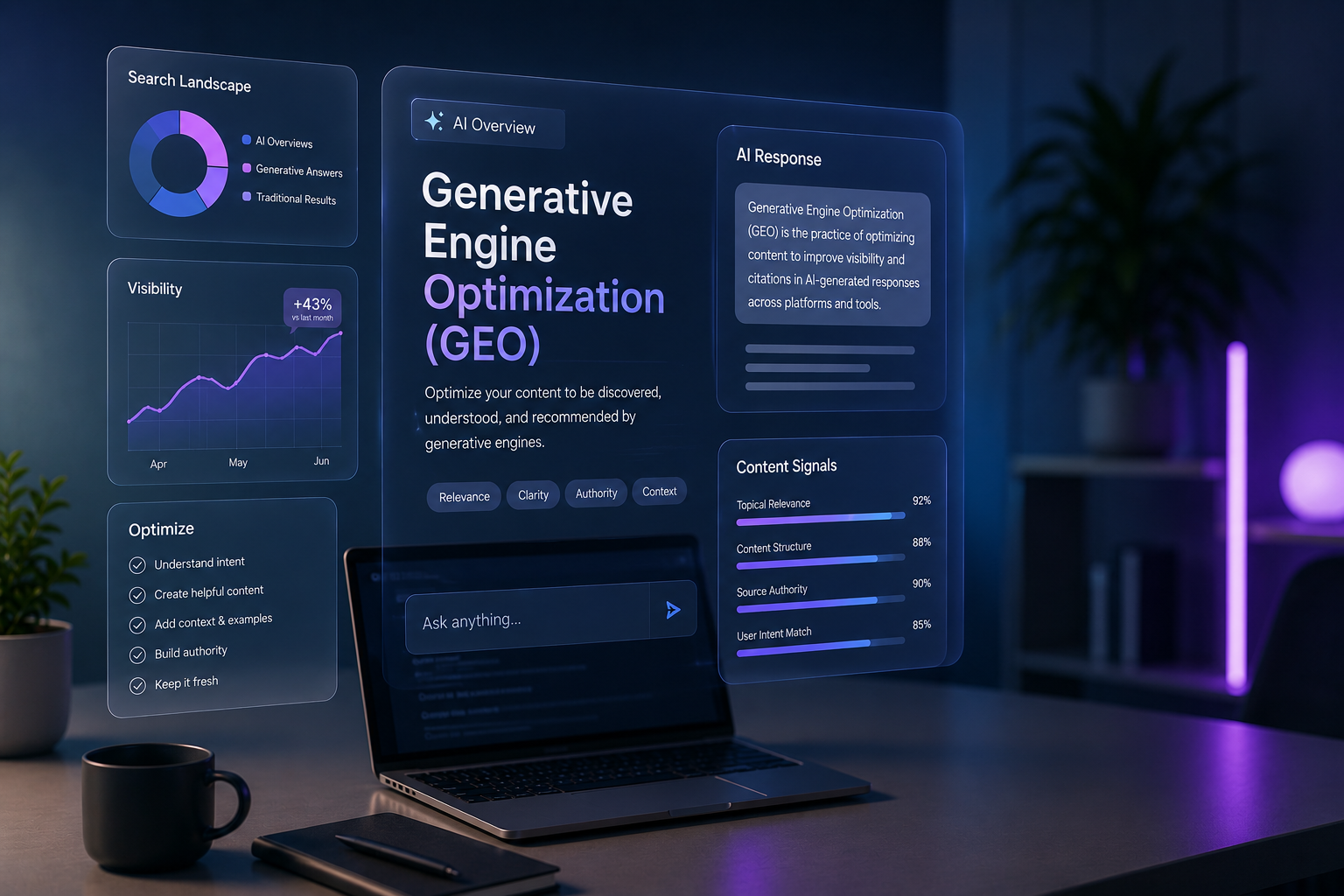
GEO — Generative Engine Optimization — is the next evolution of that idea. It is the practice of optimizing your business to appear in the answers generated by AI platforms like ChatGPT, Perplexity, Google AI Overviews, and Microsoft Copilot.
The reason it matters is straightforward: the way people search is changing. A growing number of buyers — particularly in B2B — no longer scroll through a list of Google results. They ask an AI a question and read the answer it generates. If your business is not in that answer, you are not in the consideration set.
This post explains what GEO is, how it differs from traditional SEO, and what small businesses need to do to start building visibility in AI-generated search results.
Where does the term come from?
The term Generative Engine Optimization emerged as AI-powered search tools became mainstream. Researchers and marketers needed a way to distinguish between optimizing for traditional search engines — which rank and list pages — and optimizing for generative AI systems — which read, synthesize, and write answers.
The “generative” in GEO refers to the way these AI systems produce responses: they generate new text in response to each query, drawing on the sources they have been trained on or can currently retrieve from the web. They do not return a ranked list. They write an answer.
Optimizing for that process requires a different approach than optimizing for a ranked list — though the two strategies share important common ground.
How GEO differs from traditional SEO
Traditional SEO and GEO share the same foundation — quality content, technical website health, and authoritative presence across the web. But the emphasis is different in important ways.
Traditional SEO optimizes for ranking position. The goal is to appear as high as possible in Google’s list of results for a given search term. Success is measured in rankings, organic traffic, and click-through rates.
GEO optimizes for citation and recommendation. The goal is to be named, quoted, or recommended inside an AI-generated answer. Success is measured in how often your business appears in AI responses to relevant queries — and how prominently.
Here is how the key differences break down:
| Traditional SEO | Generative Engine Optimization (GEO) | |
|---|---|---|
| Target platform | Google, Bing search results | ChatGPT, Perplexity/Claude, Google AI Overviews, Copilot |
| Output | Ranked list of links | AI-written answer with citations |
| Content priority | Keyword-optimized pages | Question-and-answer structured content |
| Key technical signals | Backlinks and page authority | Schema markup and entity consistency |
| Measurement | Rankings and organic traffic | AI citation frequency and brand mentions |
| Timeline to results | 3-6 months typically | 6-12 weeks for initial improvements |
The critical insight is that these are not competing priorities. The work you do for GEO — publishing clear, authoritative, well-structured content — also improves your traditional SEO. You are not choosing between them. You are building one content foundation that serves both.
Why GEO matters specifically for small businesses
Large brands with strong domain authority and years of SEO investment have a significant head start in traditional search. Competing for high-volume keywords against well-resourced national competitors is genuinely difficult for a small business.
GEO partially levels that playing field.
AI platforms prioritize relevance and clarity over domain authority. A small business with a well-structured, genuinely useful page that directly answers a specific query can be cited ahead of a large brand whose content is broad and generic.
For local and regional queries — “best fractional marketing team in Dallas” or “digital marketing agency for small businesses in Texas” — a well-optimized local business has a realistic chance of appearing in AI answers before national competitors who have not optimized for the local query specifically.
This is the first-mover opportunity that exists right now. Most small businesses are not doing GEO at all. The ones that start building their AI visibility today will be significantly ahead of competitors who wait another twelve to eighteen months.
The five pillars of GEO for small businesses
1. Entity clarity. AI platforms need to understand clearly what your business is, what it does, and where it operates. This means consistent, specific descriptions of your business across your website, Google Business Profile, LinkedIn, and relevant directories. Vague or inconsistent descriptions reduce the confidence AI models have in your business as a source.
2. Question-structured content. Content written in the format of a question followed by a direct, complete answer is significantly more likely to be retrieved and cited by AI platforms. Every blog post, service page, and FAQ section should be structured this way. The question should be phrased exactly as your ideal customer would type it into an AI.
3. Schema markup. Schema markup is structured data added to your website that explicitly tells AI crawlers what your business does, what questions your content answers, and how your pages relate to each other. FAQ Page, Organization, Service, and Local Business schema are the most important for small businesses and should be implemented on all key pages.
4. Content depth and authority. AI platforms favor content that demonstrates genuine expertise — not surface-level overviews but specific, detailed, accurate information that a knowledgeable person in the field would produce. This means going beyond the basics on every topic you cover, addressing nuance, and answering the follow-up questions a reader would naturally have.
5. Third-party validation. Being mentioned in other credible sources — industry directories, local business publications, partner websites, review platforms — reinforces your authority in the eyes of AI models. This is the GEO equivalent of link building in traditional SEO, and it compounds over time as your mentions accumulate.
A practical starting point for small businesses
GEO can feel overwhelming if you try to address everything at once. The most effective starting point for a small business is to focus on two things first.
Add a well-written FAQ section to every service page on your website. Write each question exactly as a customer would ask it, answer it directly and completely in the first two sentences, then add supporting detail. Enable FAQ Page schema through your SEO plugin. This alone meaningfully improves AI citation potential for your core services.
Publish two to three blog posts per week that answer the specific questions your ideal customers are asking AI platforms right now. Each post should have a question-format title, a direct answer in the opening paragraph, and a FAQ section at the bottom. Over ninety days this builds a content library that compounds your AI visibility continuously.
These two actions, executed consistently, will do more for your GEO than any single technical fix.
How GEO fits into a broader marketing strategy
GEO is not a standalone tactic. It works best as part of a coherent content and SEO strategy that builds authority across both traditional and AI search simultaneously.
For a small business, the practical sequence looks like this: build a technically sound website with proper schema markup, publish consistent question-structured content around your core topics, establish your entity presence across directories and review platforms, and promote your content through LinkedIn and email to accelerate indexing and citation.
This is exactly what iFlow’s AI Search Visibility service is designed to execute — the full GEO strategy, implemented and managed as part of a fractional marketing engagement.
If you want to understand where your business currently stands in AI search and what a GEO strategy would look like for your specific situation, start with a free audit.
Book a free AI visibility audit with iFlow
Learn more about how we approach this on our AI Search Visibility service page.
Frequently Asked Questions
GEO stands for Generative Engine Optimization. It is the practice of optimizing a business’s content, website structure, and online presence to appear in answers generated by AI platforms such as ChatGPT, Perplexity, Claude, Google AI Overviews, and Microsoft Copilot. It is distinct from traditional SEO, which focuses on ranking in Google’s list of search results.
No — GEO is an evolution of SEO, not a replacement. The two strategies share the same content and technical foundation. Businesses that invest in GEO are simultaneously strengthening their traditional SEO, because the signals that help AI platforms understand and cite your content — quality, structure, authority, schema markup — are the same signals that help Google rank your pages.
The most direct way to measure GEO progress is to regularly test queries your ideal customers would ask AI platforms — for example, typing your service category and location into ChatGPT or Perplexity — and tracking whether your business appears in the responses over time. More formally, brand mention monitoring tools can track citations across AI and web sources. iFlow’s AI Search Visibility service includes monthly monitoring and reporting on citation frequency.
GEO is primarily a content and technical investment rather than a paid advertising cost. For small businesses working with a fractional marketing team, GEO strategy and execution are typically included as part of the broader content and SEO engagement. Standalone GEO audits and implementation projects vary depending on the current state of the website and content library.
Yes, to a degree. Adding FAQ sections to your service pages, publishing question-structured blog content, and ensuring your Google Business Profile is complete and consistent are all things a business owner can do without specialist help. The more technical elements — schema markup implementation, entity profile building across directories, structured content strategy —benefit from specialist involvement, particularly if you want results faster than a DIY approach typically produces.
AEO stands for Answer Engine Optimization — an older term that described optimizing for featured snippets and voice search on traditional search engines. GEO is the more current and broader term that encompasses optimization for all AI-generated answer formats, including ChatGPT, Perplexity, Claude, Google AI Overviews, and other generative AI platforms. In practice, many marketers use the terms interchangeably, though GEO has become the more widely adopted term as of 2025–2026.
Related Reading
How to Get Your Business Found on ChatGPT, Gemini, Claude, Copilot or any other LLM?