Published on: May 29, 2026
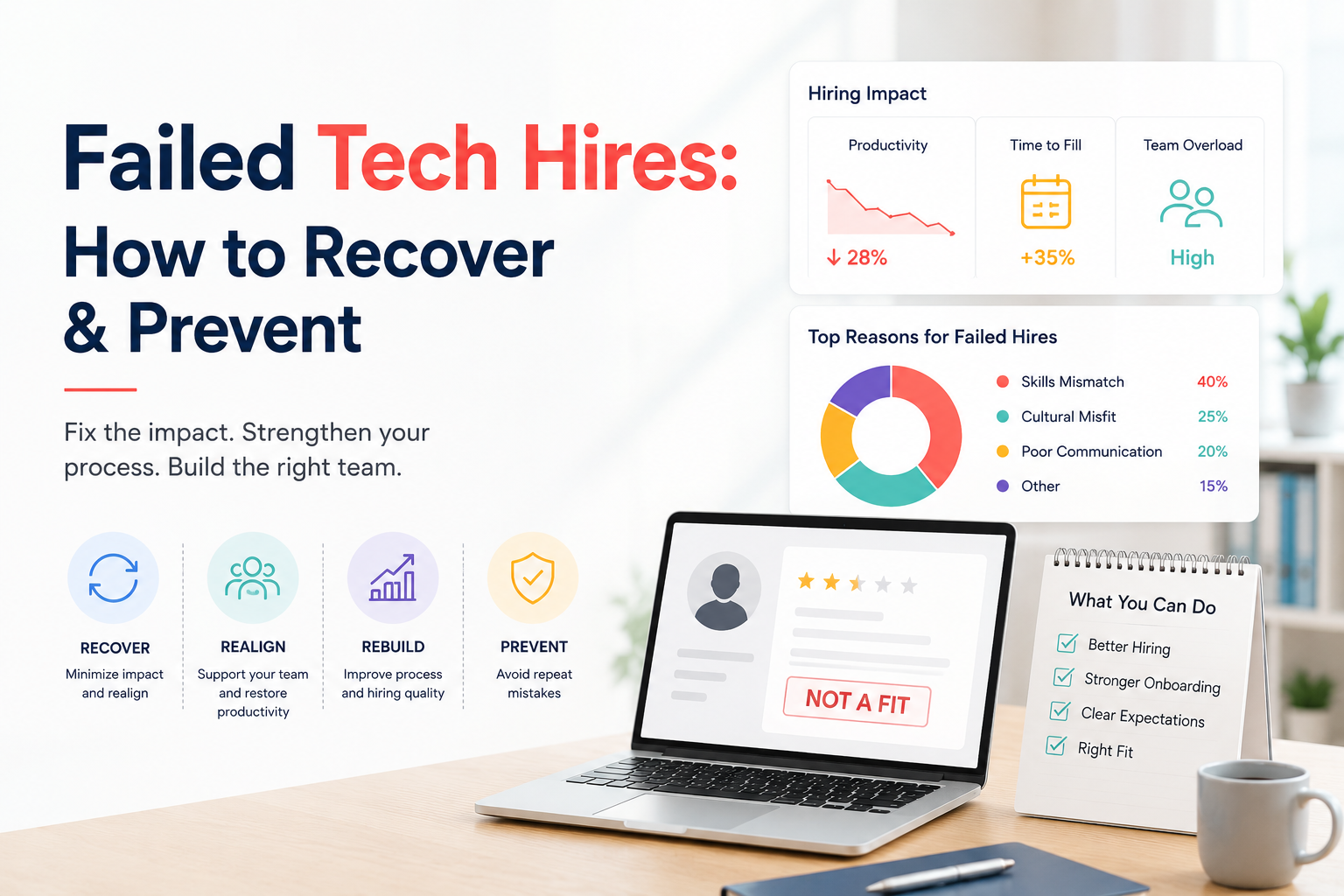
Failed Tech Hires: How to Recover & Prevent ($80K+ Cost Avoided)
[8 mins read]

You’ve invested weeks in recruiting. HR coordinated multiple interview rounds. Your engineering team carved out precious hours for technical assessments. The offer was accepted, paperwork signed, and onboarding began.
Then reality hits.
Download our Fast Track guide to scaling Tech Teams!
The new senior developer struggles with your tech stack. Code reviews reveal alarming gaps. Communication with the team is rocky. Deadlines slip. Three months in, it’s clear: this hire isn’t working out.
Now you’re facing a choice that costs money, time, and team morale no matter which direction you go.
💰 What most companies don’t realize: A single failed tech hire costs between $80,000 and $240,000 when you factor in all the real costs:
❌ Recruiting costs — agency fees, job board ads, internal time
❌ Salary and benefits paid during employment
❌ Lost productivity and delayed projects
❌ Team disruption and morale impact
❌ Severance and legal considerations
❌ Cost to rehire and restart the process
And the damage doesn’t stop at dollars. Failed hires erode team confidence, create knowledge gaps, and can derail product roadmaps for months.
This post will show you how to recognize a failing hire early, execute a recovery plan, and — most importantly — prevent it from happening again.
⚠️ Warning signs: is this hire failing?
Not every rough start means a failed hire. New developers need ramp-up time, and cultural adjustment takes weeks. But certain patterns signal deeper problems.
🔴 Technical red flags
| Timeframe | Red flags to watch for |
|---|---|
| Week 1–2 | Struggles with basic dev environment setup · Unfamiliar with fundamental tools (Git, CI/CD, testing) · Can’t articulate technical decisions or problem-solving approach |
| Week 3–6 | Code quality significantly below team standards · Repeated bugs requiring extensive rework · Unable to complete starter tasks without constant guidance · Pushes code that breaks builds or tests |
| Week 7–12 | No improvement trajectory despite feedback · Still operating at junior level despite senior title · Creates technical debt faster than value |
🔴 Communication and collaboration red flags
⚠️ Misses stand-ups or doesn’t participate meaningfully
⚠️ Doesn’t ask questions when clearly stuck
⚠️ Dismissive of code review feedback
⚠️ Works in isolation, doesn’t integrate with team rituals
⚠️ Overpromises on timelines, consistently underdelivers
⚠️ Blames tools, processes, or teammates for their struggles
🔴 Cultural misalignment red flags
⚠️ Values clash with team norms
⚠️ Resistant to your development methodology (Agile, Scrum, etc.)
⚠️ Negative attitude toward learning or adapting
⚠️ Creates tension or complaints from other team members
📋 The 30-60-90 day performance framework
To catch problems early and give hires a fair chance, establish clear expectations from day one. Here is what each phase should look like:
| Phase | Expected outcomes | Evaluation checkpoint |
|---|---|---|
| First 30 days Foundation |
Environment fully configured · Understands codebase and team workflows · Completed 2–3 small tasks · Attended all meetings and 1:1s | Can they work independently on small tasks? Are they asking smart questions? Are they integrating into team communication? |
| Days 31–60 Contribution |
Completed 1–2 meaningful features · Participates in code reviews · Resolved blockers independently · Building team relationships | Is code quality meeting standards? Are they increasing velocity or creating drag? Do teammates trust their work? |
| Days 61–90 Ownership |
Takes ownership of features end-to-end · Mentors others if senior · Proactively identifies improvements · Delivers consistently | Would you assign them critical work? Are they net-positive to team velocity? Do they fit culturally and technically? |
🔧 Recovery protocol: what to do when a hire isn’t working
Step 1: Document everything (Days 1–7)
Before taking any action, build a clear record. Specific examples of performance gaps, feedback already provided and responses, impact on team and project timelines, and any attempts at coaching or support. This protects your company legally and ensures fairness.
Step 2: Have the honest conversation (Week 1)
Schedule a private meeting with the struggling hire. Be direct but professional. The framework:
💡 Conversation framework
🗣️ “Here’s what we’re observing…” — specific examples only, no generalizations
🗣️ “Here’s the gap between expectations and current performance…”
🗣️ “Here’s what needs to change…” — measurable, time-bound goals
🗣️ “Here’s the timeline and support we’ll provide…”
Then set a 30-day improvement plan with: weekly check-ins, clear measurable deliverables, an assigned mentor or buddy, and any training or resources needed.
Step 3: Execute the improvement plan (Weeks 2–5)
Track performance against stated goals consistently. Provide feedback in real time — don’t save it for the end. Offer genuine support through training, pairing, or adjusted workload. Keep HR and leadership informed throughout.
Two outcomes are possible: performance improves — continue with closer monitoring — or no meaningful improvement — prepare for termination.
Step 4: Make the decision (Week 6)
If improvement isn’t happening, the path forward depends on the employment type:
| Employment type | Steps to take |
|---|---|
| At-will employment (most U.S. states) | Consult HR and legal counsel · Prepare severance offer if appropriate · Plan knowledge transfer · Schedule termination meeting |
| Contract or contract-to-hire | Review contract terms for early termination · Work with staffing partner if applicable · Typically faster and less complicated than FTE termination |
Step 5: Execute termination professionally (Weeks 6–7)
☐ Keep the meeting brief and factual — HR should be present
☐ Collect company property (laptop, badges, access cards)
☐ Revoke system access immediately
☐ Provide final paycheck and severance details in writing
☐ Offer to answer questions about benefits and references
☐ If possible, allow 1–2 week transition — document their work, credentials, and project status
☐ Reassign their tickets and responsibilities immediately
💰 The real cost of a failed hire — broken down
Here is what a failed senior developer hire actually costs over 6 months:
| Cost category | Amount |
|---|---|
| Recruiting (agency fee @ 20%) | $24,000 |
| Salary (6 months @ $140K annual) | $70,000 |
| Benefits and overhead (30%) | $21,000 |
| Onboarding time (team hours) | $8,000 |
| Lost productivity | $15,000 |
| Project delays | $30,000 |
| Severance (2 weeks) | $5,400 |
| Total — failed hire cost | $173,400 |
| New recruiting cycle | $24,000 |
| 6–8 weeks delay (opportunity cost) | $20,000+ |
| Grand total | $217,400+ |
And that doesn’t include the morale hit to your team or the risk to client relationships.
🛡️ Prevention: how to avoid failed hires
1. Improve your screening process
Technical assessments must be relevant to your actual work — not abstract algorithm puzzles. Use real (sanitized) code from your codebase, test for the actual tools and frameworks you use, and include debugging or code review exercises. Behavioral interviews matter just as much: ask about past conflicts and how they were resolved, explore why they left previous roles, and gauge learning agility and communication clarity.
2. Use contract-to-hire to de-risk
One of the most effective ways to prevent failed permanent hires is to test before you commit.
| Contract-to-hire approach | Why it works |
|---|---|
| Hire on 3–6 month contract first | Reduces hiring risk by 60–70% |
| Evaluate real performance on real projects | No surprises — you see exactly how they work |
| Convert to full-time only after proven success | Exit is easy and clean if it’s not working |
| Often faster to start than full-time recruiting | Fills the gap while protecting the long-term decision |
Read More on Contract vs Permanent Tech Hiring: What’s Right for Your Business?
3. Set clear expectations from Day 1
Ambiguity kills. Clarity saves. Every new hire should receive: a written 30-60-90 day performance plan, clear role responsibilities and success metrics, team norms and communication guidelines, and technical standards and code quality expectations — before they write their first line of code.
4. Assign a buddy or mentor
Pair each new hire with an experienced team member who can answer questions in real time, provide informal feedback, help navigate team dynamics, and spot problems before they compound. This one step consistently accelerates ramp time and surfaces red flags early.
5. Conduct weekly check-ins for the first 90 days
Don’t wait for quarterly reviews. Short weekly 1:1s let you surface blockers immediately, course-correct early, build trust and communication, and identify red flags before they become expensive problems.
6. Work with specialized staffing partners
If failed hires are a recurring problem, the issue is likely your sourcing and vetting process. Specialized partners like iFlow pre-screen candidates for technical depth, test for your specific stack and tools, assess cultural and communication fit, offer contract-to-hire options to reduce risk, and replace poor fits quickly if needed.
Read More on Developer Quit Unexpectedly? Emergency Tech Hiring Protocol
📊 Case study: recovering from a failed hire
A Denver-based SaaS company hired a senior React developer at $155K. After 10 weeks it was clear the hire wasn’t working — poor code quality, missed deadlines, and team friction. They terminated at Week 12 and immediately contacted iFlow.
iFlow delivered 3 pre-vetted React developers within 48 hours. One was hired on a contract-to-hire basis, onboarded in 3 days, delivered critical features within the first sprint, and converted to full-time after 90 days.
| Approach | Cost |
|---|---|
| Failed direct hire (10 weeks) | ~$185,000 |
| Contract-to-hire replacement (6 months) | ~$95,000 |
| Cost avoided on next hire | Priceless |
Read More on Choosing the Right IT Staffing Partner – What Tech Leaders Must Know
✅ What to do right now if you have a failing hire
This week:
☐ Document specific performance issues with concrete examples
☐ Schedule a direct, private conversation with the hire
☐ Loop in HR to review your options
☐ Start a 30-day improvement plan if there is genuine potential
Next 30 days:
☐ Execute improvement plan with weekly check-ins
☐ Provide resources, mentorship, and clear feedback
☐ Decide by Day 30 — continue or terminate
Meanwhile:
☐ Contact a staffing partner to pre-qualify backup candidates
☐ Consider contract-to-hire for the replacement
☐ Review your hiring process to prevent repeat failures
Failed hires are expensive — but preventable
Here’s the truth: even the best hiring processes produce some failures. Markets change, candidates misrepresent skills, and sometimes fit just isn’t there.
But you can dramatically reduce your failure rate by:
✅ Improving technical and cultural screening
✅ Using contract-to-hire to test before committing
✅ Setting clear 30-60-90 day expectations
✅ Catching problems early with weekly check-ins
✅ Working with specialised staffing partners who pre-vet rigorously
And when you do have a failed hire, act fast. Every week of delay compounds the cost.
⚡ Need a replacement fast?
If you need to replace a failed hire within 48–72 hours, iFlow can help. We maintain pre-vetted talent pools of developers, DevOps engineers, and specialists who can start immediately. Contact iFlow for emergency hiring support.
Frequently Asked Questions
Ans: 30 days with a structured improvement plan is standard. If there’s no meaningful progress by then, it’s unlikely to change. Act decisively.
Ans: In most U.S. states, yes—employment is “at-will.” However, always consult with HR and legal counsel before terminating to ensure compliance and avoid wrongful termination claims.
Ans: It depends. Severance isn’t legally required in most cases, but offering 1-2 weeks can smooth the exit and reduce legal risk. Consult your legal team.
Ans: Be transparent (without oversharing details). Acknowledge the disruption, reassure the team about the path forward, and fill the gap quickly. Involve the team in the next hire if possible.
Ans: Yes. It lets you evaluate real performance over 60-90 days before committing. If it’s not working, you can end the contract with minimal cost and complexity.
Ans: With a staffing partner like iFlow , you can have pre-vetted replacement candidates within 48-72 hours and onboarded within a week. Contact us for emergency hiring.
💰 Download: 2026 Tech Salary Benchmark Report.
Plan compensation bands and avoid overpaying (or losing talent). Real market data across 25 tech roles.
Download Free Report ➡️