Published on: May 27, 2026
Is Your Competitor Showing Up in AI Answers — and You’re Not? Here’s Why
[10 mins read]

Try this right now. Open ChatGPT or Claude / Perplexity and type the question your ideal customer would ask when looking for a business like yours.
Something like “best fractional marketing agency for small businesses in Dallas” or “who provides IT staffing services in Texas.”
Read the answer carefully. Are you in it?
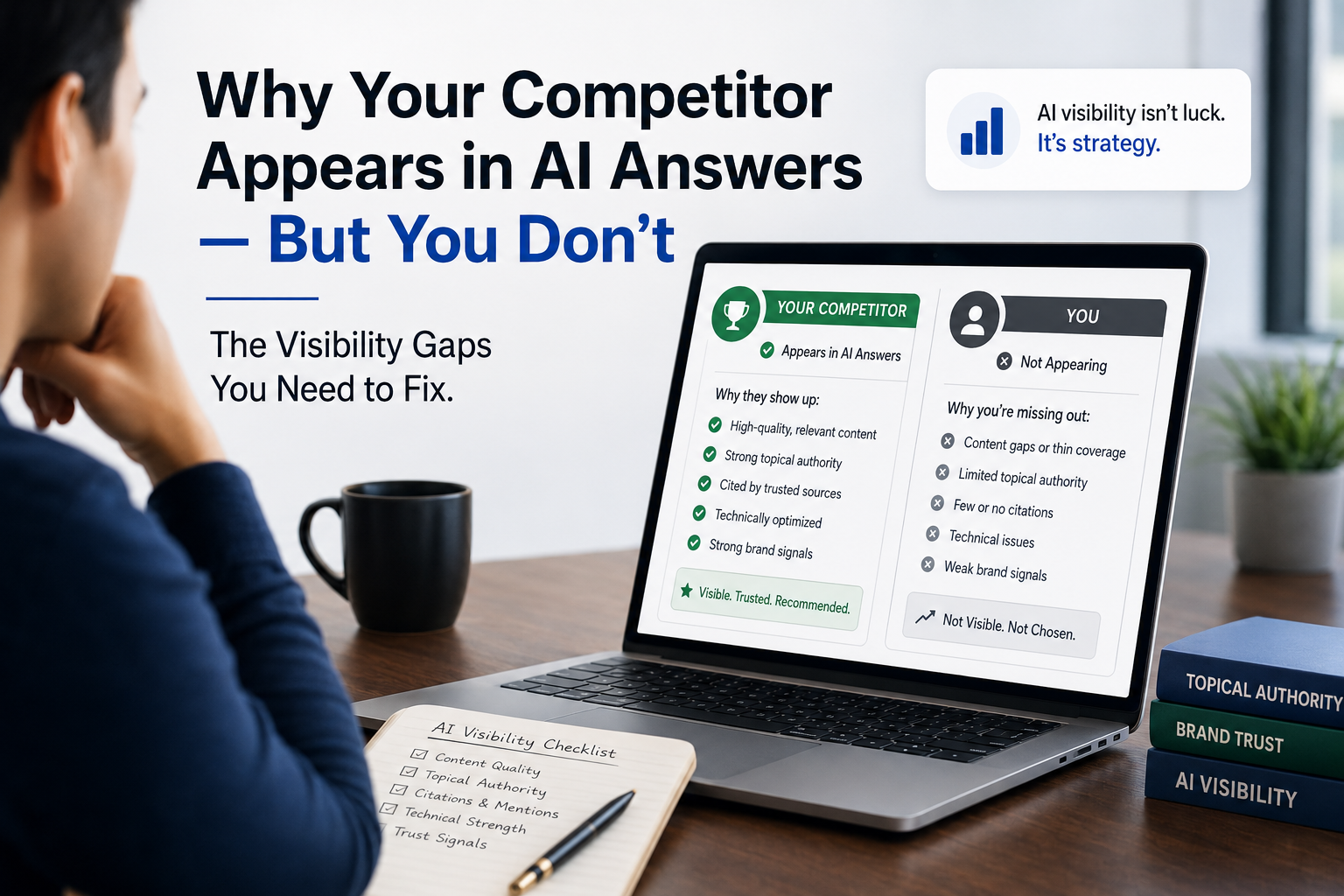
If your competitors appear and you do not, that is not an accident and it is not random. There are specific, identifiable reasons why some businesses get cited in AI-generated answers, and others do not — and every one of those reasons is fixable.
This post explains exactly what those reasons are and what to do about each one.
Why AI citations are not random
It is tempting to assume that AI platforms recommend businesses arbitrarily — that appearing in an AI answer is a matter of luck or perhaps just being large enough to have broad name recognition.
Neither is true.
AI platforms retrieve and cite content based on a set of consistent signals. Those signals can be understood, built, and optimised for — exactly the way Google rankings can be understood and optimised for. The businesses that appear in AI answers are not there by chance. They have — usually without realising it — done the things that make AI platforms trust and cite them.
The businesses that are absent have not done those things. The gap is almost never about budget, brand size, or how long the business has been operating. It is almost always about content structure, entity consistency, and publishing depth.
Here is what separates the businesses that appear from those that do not.
Reason 1: Your competitor has more content on the topic
The most common reason a competitor appears in AI answers and you do not is simply that they have published more content about the topic the buyer asked about.
AI platforms draw from the web content they have indexed and retrieved. A competitor who has published ten blog posts about fractional marketing — what it is, what it costs, who it is for, how to choose a provider — has given AI platforms ten opportunities to cite them on fractional marketing queries. A business with one service page and no blog content has given AI platforms almost nothing to work with.
This is the most fixable of all the reasons. It requires no technical expertise and no budget — only a consistent content publishing schedule and the discipline to maintain it. At two posts per week, a business can close a significant content gap within sixty to ninety days.
The question to ask is not just “do we have a page about this topic” but “do we have enough content about this topic that an AI would consider us a credible, authoritative source?”
Reason 2: Your competitor’s content is structured for AI retrieval
Having content is necessary but not sufficient. The way that content is structured determines whether AI platforms can easily extract and use it in a response.
Content that AI platforms retrieve most readily shares specific structural characteristics: it answers a question directly in the first paragraph rather than building to an answer slowly, it uses the question itself as a heading, it provides complete and specific information rather than vague generalities, and it includes FAQ sections that make question-and-answer pairs explicit.
A competitor whose blog posts open with a direct answer to the question in the title — and whose service pages end with a well-structured FAQ section — is giving AI platforms exactly the format they prefer to cite. A business whose content is well-written but buries the answer three paragraphs in, or uses vague language like “we provide comprehensive marketing solutions,” is much harder for an AI to use.
Auditing your existing content for this structural issue — and updating pages to front-load direct answers — can improve AI citation frequency for existing content without creating anything new.
Reason 3: Your competitor has a stronger entity presence across the web
AI platforms do not evaluate businesses based solely on their website. They cross-reference multiple sources to establish whether a business is a credible, recognised entity in its field.
Those sources include Google Business Profile, LinkedIn company page, industry directories like Clutch, G2, and UpCity, review platforms, local business directories, press mentions, and partner website references.
A competitor who is listed consistently across all of these — with the same business name, description, services, and location — sends strong entity signals that AI platforms use to validate credibility. A business that exists only on its own website, or that has inconsistent information across different platforms, sends weak entity signals.
The fix is methodical rather than creative: audit every place your business is listed online, ensure the information is accurate and consistent, and add listings to the directories and platforms where you are absent. This is a one-time investment with ongoing returns.
Reason 4: Your competitor has reviews and your business does not
When an AI platform recommends a business in response to a query like “best marketing agency in Dallas,” it is not just looking at content quality. It is also looking at third-party validation — evidence that real customers have used and valued the business.
Google reviews, Clutch ratings, G2 scores, and Trustpilot reviews all feed into the signals AI platforms use when evaluating which businesses to recommend. A competitor with forty Google reviews averaging 4.8 stars and a verified Clutch profile with client testimonials is significantly more likely to appear in an AI recommendation than a business with three reviews and no directory presence.
The fix is simple but requires consistent execution: ask satisfied clients for reviews at the right moment — immediately after a positive outcome, when the relationship is warm and the value is fresh. One personalised request at the right time produces a review far more reliably than a generic reminder sent weeks later.
Reason 5: Your competitor’s website has schema markup and yours does not
Schema markup is structured data added to a website that explicitly tells search engines and AI crawlers what a business does, where it operates, and what questions its content answers.
FAQPage schema, Organisation schema, LocalBusiness schema, and Service schema are the most important for small businesses. A website with this markup is significantly easier for AI platforms to categorise and cite than one without it — the AI does not have to infer what the business does, it is told directly in a machine-readable format.
Most small business websites have no schema markup at all. If your competitor’s website has it and yours does not, they have a structural advantage in AI citation that costs almost nothing to close. On a WordPress site with Yoast SEO installed, FAQPage schema can be added to any page with a FAQ block in under ten minutes.
Reason 6: Your competitor publishes more consistently than you
AI platforms weight recency as part of their content evaluation. A business that publishes new content regularly signals that it is active, current, and engaged in its field. A business that published its last blog post eight months ago signals the opposite.
This is not about publishing volume for its own sake. It is about demonstrating ongoing relevance and expertise in a topic area. A competitor who publishes two thoughtful, well-structured posts per week about their field is building topical authority — the accumulated signal that they are a genuine expert source — at a rate that is difficult to match without a similar commitment.
The practical implication: if your competitor is publishing consistently and you are not, the gap in AI citation frequency will widen over time, not narrow. Closing it requires committing to a publishing schedule and maintaining it.
How to audit your own AI visibility against competitors
Before taking any action, it helps to understand the gap clearly. Here is a simple audit you can complete in under thirty minutes.
Step 1 — Identify your two or three most direct competitors. Choose businesses that serve the same customer, in the same geography, with a similar service.
Step 2 — Run five queries across AI platforms. Open ChatGPT, Claude /Perplexity, and Google and type five queries your ideal customer would use. Note which businesses appear in the answers, whether you appear, and whether your competitors appear.
Step 3 — Audit your competitors’ websites. Note how many blog posts they have on relevant topics, whether their pages have FAQ sections, whether headings are structured as questions, and whether schema markup is visible in the page source.
Step 4 — Check their directory and review presence. Search each competitor on Clutch, G2, Google Business, and LinkedIn. Note how complete and consistent their profiles are, how many reviews they have, and what their ratings are.
This audit will tell you exactly where the gaps are and which of the six reasons above is most responsible for the difference.
Closing the gap: where to start
If the audit reveals that competitors are ahead of you, here is the priority sequence for closing the gap:
First — fix your content structure on existing pages. Update service pages and blog posts to front-load direct answers, add question-format headings, and add FAQ sections. This improves AI citation potential for content that already exists without requiring anything new to be created.
Second — add schema markup to your key pages. FAQPage schema on service pages and blog posts is the highest-impact technical change most small businesses can make in the shortest time.
Third — complete and standardise your entity presence. Google Business Profile, LinkedIn, and two or three relevant industry directories should all have consistent, complete, accurate information about your business.
Fourth — build a review presence. Ask your three most satisfied recent clients for a Google review this week. Do not wait for the perfect moment — the right moment is any moment when the relationship is warm.
Fifth — commit to a consistent publishing schedule. Two quality posts per week, structured for AI citation, maintained consistently over ninety days, will close most content gaps with competitors who have not been publishing deliberately.
How iFlow helps businesses close the AI visibility gap ?
iFlow’s AI Search Visibility service is built specifically around the six factors above — Content Depth, Content Structure, Entity Presence, Reviews, Schema Markup, and Publishing Consistency. We audit where your business stands relative to competitors, identify the highest-priority gaps, and execute the strategy to close them.
For businesses that want to be the one their buyers find in AI answers — rather than watching a competitor get recommended — the starting point is understanding exactly where the gap is.
Book a free AI visibility audit — we will show you where your business stands in AI search relative to your competitors and what the gap would take to close.
Visit our AI Search Visibility service page to learn more about how we approach this.
Frequently Asked Questions
Ans: The most common reasons are that your competitor has published more content on the topic, their content is structured with direct answers and FAQ sections that AI platforms can easily retrieve, they have a stronger entity presence across directories and review platforms, they have more customer reviews, or their website has schema markup that yours does not. All of these are fixable — the audit process described in this post will tell you which gaps are largest for your specific situation.
Ans: Open ChatGPT, Claude/ Perplexity, and Google, and type the questions your ideal customers would ask when looking for a business like yours. Read the responses and note whether your business is mentioned. Do this for five to ten different query variations — some queries will return different results than others. This gives you a practical baseline of your current AI visibility.
Ans: Yes — this is one of the most significant differences between AI search and traditional SEO. AI platforms prioritize the clarity, depth, and structure of content over domain authority and marketing budget. A small business with well-structured, authoritative content on a specific topic can outperform a large national competitor whose content is broad and generic. Local and niche specificity is a particular advantage for small businesses in AI search.
Ans: The fastest improvements come from fixing content structure on existing pages — adding direct-answer openings, FAQ sections, and schema markup. These changes can improve AI citation frequency within four to eight weeks for content that is already indexed. Building topical authority through consistent new content publishing takes longer —typically three to six months — but compounds over time in a way that structural fixes alone do not.
Ans: Being behind a competitor in AI search visibility is a problem worth addressing — but it is not cause for alarm. AI search is still relatively early, most small businesses have not optimized for it deliberately, and the gap is closeable with focused effort over three to six months. The businesses that should be most concerned are those that continue to ignore AI search while their competitors build visibility — because the gap compounds over time and becomes harder to close the longer action is delayed.
Related Reading
How to Get Your Business Found on ChatGPT, Gemini, Claude, Copilot or any other LLM?
What is Generative Engine Optimization (GEO)?
Google AI Overviews explained: what they are and how to appear in them
AI Search Visibility services — iFlow
The state of digital marketing for Texas small businesses in 2026